For Luxury Residential Real Estate

The advisor who earns trust before the site visit.

In luxury residential real estate, the advisor who commands the conversation commands the transaction.

The Challenge

The problem isn't your listings. It is how the market perceives you before you arrive.


HNI buyers do not evaluate luxury residential real estate the way retail buyers do. They evaluate the advisor first. Before they look at a property, they are deciding whether the person showing it to them is worth trusting. The listing is secondary to the person presenting it.

The advisor who is positioned clearly receives a different kind of referral. The client arrives knowing what to expect, which means the conversation begins from a different place. There is no need to establish credibility from scratch. The positioning has already done that work.

Luxury residential real estate advisor in a premium property advisory setting.

The tactics built for volume advisors do not work for advisors who serve discretionary buyers.


Editorial image representing volume signals rather than depth.
Volume signals, not depth

A generic social media presence signals that you serve everyone, which communicates the opposite of the bespoke advisory relationship that HNI buyers require. It does not differentiate you - it positions you alongside every other advisor in the market.

Editorial image representing the wrong prospects at the door.
The wrong prospects at the door

Volume-based lead generation is designed to attract as many enquiries as possible. For luxury real estate advisors, it reliably attracts price-sensitive buyers who will negotiate on commission and question every recommendation - not clients who value judgement and pay for it.

Editorial image representing persuasion reading as pressure.
Persuasion reads as pressure

Persuasion-heavy tactics - urgency, comparison, social proof built for retail markets - erode trust with sophisticated buyers. They read it as pressure, not competence. The advisor who relies on these tools is confirming that they don't understand who they are speaking to.

What changes

When your positioning is right, the conversation is different before it begins.


Editorial image representing prospects arriving pre-qualified.
Prospects arrive pre-qualified

When your positioning is precise, the right clients self-select before the first conversation. They already understand what you offer, why it is different from a transactional broker, and why that matters to them. The introductory meeting becomes a confirmation rather than an audition.

Editorial image representing referrals that are more specific and matched.
Referrals are more specific and better matched

When your market position is clear, the people who refer you have the language to describe who you are best suited to serve. The referral carries a specific recommendation to a specific type of client - not a general endorsement that could apply to any advisor in the city.

Editorial image representing the advisor leading the conversation.
The advisor leads the conversation

When trust is established through positioning before the meeting begins, the advisor is in a position to guide the client - not respond to their agenda. The conversation follows the advisor's structure, which is the structure that leads to better outcomes for the client and a more coherent transaction for everyone involved.

Editorial image representing fees reflecting value rather than price.
Fees reflect value, not price comparisons

The conversation about cost comes after the conversation about capability - not at the start of it. When clients understand what an advisor's judgement is worth, the question of fees resolves differently. Positioning changes the frame within which compensation is discussed.

The books and curriculum are built with your context in mind.


The Trusted Advisor by Satish Rao

Book One

The Trusted Advisor

Leading HNI buyer conversations with authority. For advisors who are in the room and want to hold the frame from the first minute.

Read more about this book
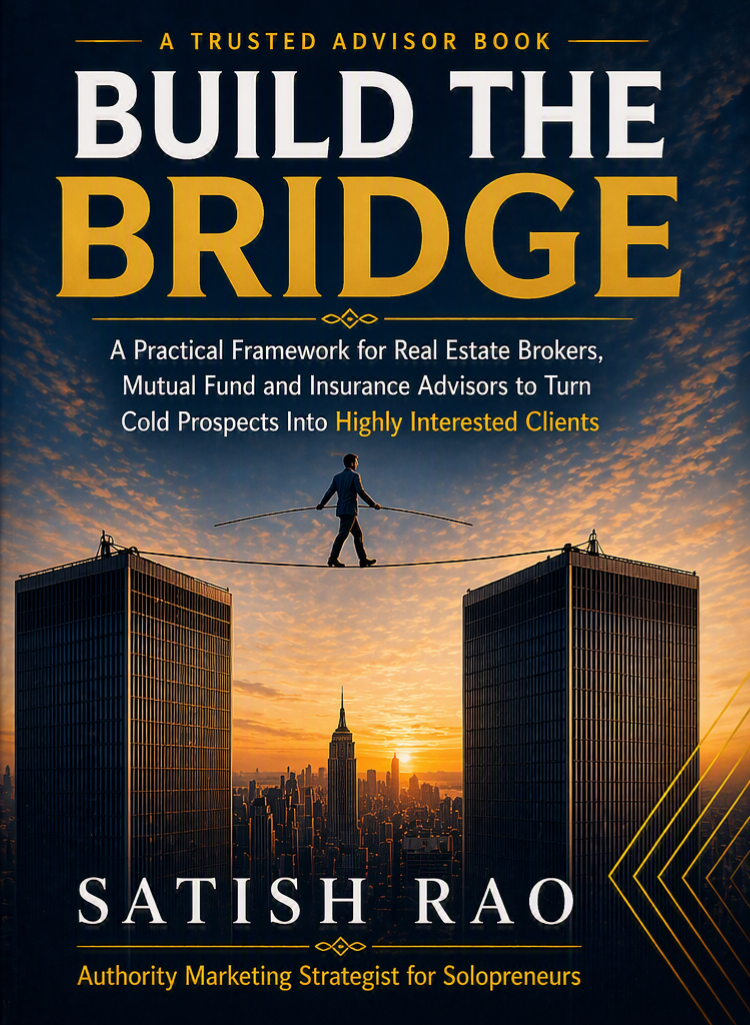
The Bridge by Satish Rao

Book Two

The Bridge

Positioning in the market as a luxury real estate authority. Builds a presence that draws the right clients before any selling conversation begins.

Read more about this book
What Advisors Say

In their own words.


"When I came to this work, I had fourteen years in luxury real estate and a practice that was performing well by most measures. What I did not have was a way to articulate what made my approach distinct from the dozen other advisors operating at a similar ticket size in my city. The curriculum gave me a framework for that articulation."

Luxury Real Estate Advisor
Maharashtra

"The positioning work changed the conversations I was having before the site visit even happened. Referrals started coming with a much clearer expectation of what I do and who I am best suited to work with."

Senior Real Estate Advisor
Pune

"I used to prepare extensively for every first meeting. After repositioning, the preparation shifted. I spent less time rehearsing my pitch and more time understanding who I was meeting. The conversations changed entirely."

Luxury Real Estate Advisor
Bengaluru

"HNI buyers in my market make their decision about the advisor in the first seven minutes. What I learned is that seven minutes is not enough to build trust from scratch - it has to be built before they walk in."

Real Estate Advisor
Hyderabad

"My referral network was strong. What was weak was the brief that accompanied each referral. After working on positioning language, the brief changed. Clients arrived knowing what to expect."

Senior Advisor
Mumbai

"Being known and being positioned are different things. Being known means people remember your name. Being positioned means they remember what you stand for. This work helped me make that shift."

Real Estate Advisor
Pune
Private Access

Request private access to the advisor community

Get resources and support relevant to luxury residential real estate advisory. Free to join.

  • Positioning frameworks

    Practical frameworks for building authority before first contact — shared directly from Satish's advisory work.

  • A peer community of serious advisors

    Connect with experienced advisors across India working on the same positioning and trust-building challenges.

  • Case study discussions

    Deep dives into real advisor repositioning stories — what changed, what worked, and why it worked.

  • Resources and templates

    Downloadable tools, referral briefs, positioning language guides, and conversation starters.

  • Direct updates from Satish

    New insights, book excerpts, and community-first material as they are developed — before anywhere else.

Request private access

Free to join — no spam — leave at any time.

Start with the diagnostic or the books - both are built for where you are.

Questions

The framework and curriculum are designed specifically for advisors - individuals who build ongoing relationships with HNI buyers and sellers, guide decisions across transactions, and whose standing in the market is built through trust rather than inventory. Developers operate in a different market structure, with different client relationships and different positioning requirements. If you are an advisor working with developer projects, the positioning principles apply to how you present yourself - not to how the developer positions their project.

In the luxury residential segment, the inventory is visible to multiple advisors. What differentiates one advisor from another is not access to listings - it is the client's confidence in the person advising them. HNI buyers are purchasing a decision that involves significant capital, personal identity, and long-term consequences. They are not primarily evaluating properties; they are evaluating the adviser's ability to guide a high-stakes decision. Positioning is the signal that reaches them before the first meeting and shapes how they interpret everything that comes after it.

The first change is usually in how the advisor describes themselves - not in marketing materials, but in conversation. When you have a clear and specific account of who you serve, what you offer, and why your approach is different, the language you use in introductory meetings changes. That change in language affects how clients read the conversation. The second change, which follows from the first, is in the quality of referrals. When the people in your network have the right language to describe you, they refer the right clients. The diagnostic is designed to surface exactly where this process is breaking down.

Most experienced luxury real estate advisors rely on referrals. The issue is not whether referrals are coming in - it is the precision of those referrals. When your positioning is unclear, referrals arrive with a general endorsement: "You should speak to this person." When your positioning is clear, referrals arrive with a specific recommendation: "This person is exactly right for what you are trying to do." The difference in client quality between these two types of referral is significant. Positioning work is, in large part, the work of giving your referral network the language they need to send you the right clients - not just any clients.

Most advisors notice changes in referral quality within 60–90 days. Full market repositioning - where your name is associated with a clear and specific standing - typically takes 9–12 months. The investment is front-loaded; the returns compound.

No. Repositioning is about how the market perceives you before the relationship begins - not about the work you do within established relationships. Most advisors find that existing clients affirm the repositioned language when they encounter it. It names something that was already true.

The positioning principles apply across markets. Advisors in tier-2 cities often find that precise positioning is even more valuable - there is less noise to cut through, and a clearly positioned advisor in a smaller market often gains referral quality faster than one in a large, noisy metro.